Tag: bread

French Onion Soup

French Onion Soup

French Onion Soup
French Onion Soup

French Onion Soup

Yesterday, I was craving French Onion Soup. I found a recipe on Smitten Kitchen (duh) and luckily, we had most of the ingredients except wine, broth, and swiss cheese. After work, I swung by the grocery store, picked up what I needed, and I was ready to go. I halved the recipe, but I’ll give you the original in case you’re cooking for more than just two people (but half was the perfect amount for me and Jonah).

French Onion Soup

Ingredients

1 1/2 pounds (5 cups) thinly sliced yellow onions
3 tablespoons unsalted butter
1 tablespoon olive oil
1 teaspoon table salt (or less)
1/4 teaspoon granulated sugar
3 tablespoons all-purpose flour
2 quarts beef stock (mushroom stock is a good vegetarian substitute)
1/2 cup dry white wine
Freshly ground black pepper
1 to 2 cups (to taste) grated Swiss or Gruyere cheese
Butter
Crusty bread, sliced into 1 inch thick pieces toasted until hard

Instructions

Melt the butter and oil together in a large saucepan over medium-low heat. Add the onions, tossing to coat them in the butter/oil, and spread them so they cover the bottom of the pot. Reduce the heat and let the onions cook, covered, for 15 minutes. You don’t need to stir them during this step.

After 15 minutes, turn up the heat a little bit and stir in the salt and sugar. Cook them for 30-40 minutes until they have become a lovely golden brown, stirring frequently so they don’t burn. Yes, 30 minutes seems like a long time to stir onions, but allowing them to caramelize well will make for really nice flavor later on and will make the soup taste much more complex and, well, just better.

Once the onions are browned, add the flour, stirring it in well, and cook for another 3 minutes. Now add the wine (all at once) and the stock, a bit at a time, stirring between additions. Add a little salt and pepper. Be sure not to over-salt! The stock is plenty salty and the cheese on the gratinée is plenty salty, so don’t overdo it now. Once the stock is all in, bring the pot to a simmer and let is cook, partially covered, for another 30-40 minutes. And stir in the cognac if you’re using it.

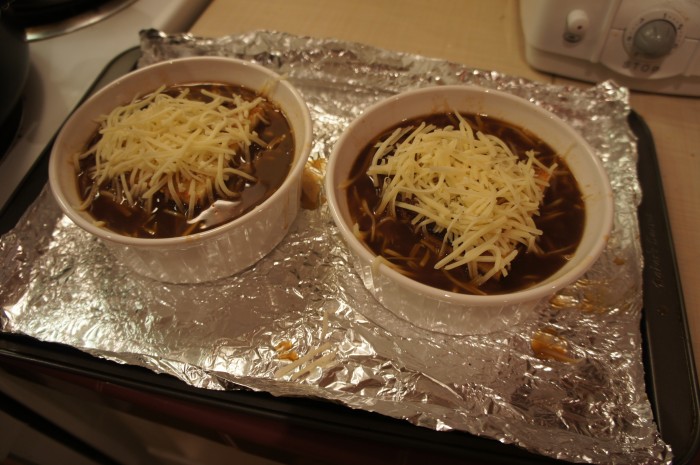
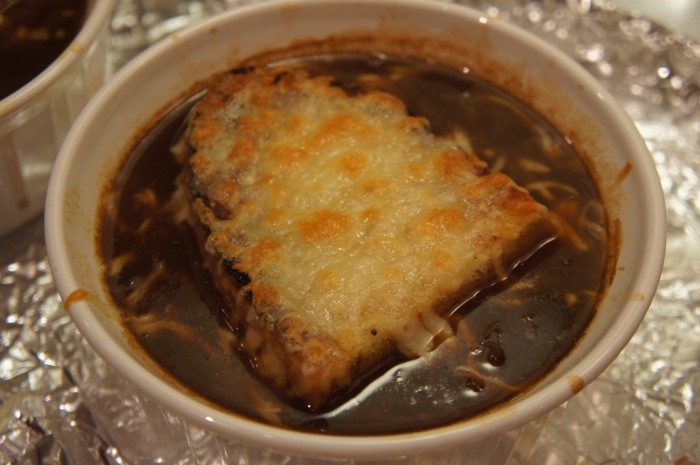
Now for the gratinée. Jonah and I didn’t follow instructions, but rather chose to just try out our own process and see if it worked. It did. Turn on your broiler (we put ours on high). Pour the soup into oven safe bowls, and stir in about 1 Tbl of the cheese. Toast whatever bread your using (we used the bread I made in the previous post) until it’s hard. Butter the toast, and set it afloat on the soup. Now put on as much cheese as your little heart desires. We probably did 1/3 of a cup per bowl of soup. Put the bowls on a foil-lined baking sheet, and pop it in the oven. I watched the soups in the oven, and when the cheese was bubbling and starting to turn golden brown, I pulled them out of the oven. Be careful as the bowls will be HOT. Put them on plates and warn whoever is eating them not to touch the bowl, only the plate. Serve and enjoy!

Country Bread

Country Bread

Country Bread
Country Bread

Country Bread

The reason I started making bread is because I’ve always wanted to make one of those crusty light loaves that you find at Grand Central Bakery or Macrina Bakery or Lovejoy Bakers. I’m getting closer, starting with simple white loaves and now moving on to this Country Bread. One day I know I’ll get to one of those crispy on the outside, light and soft on the inside, perfectly sour sourdoughs.

Anyway, my aunt Judy sent me a cookbook (as well as a book about how to write recipes) when I started this blog. It’s called “Flour” by Joanne Chang, who is the chef at a bakery in Boston (where my aunt lives). I’ll admit, many of the recipes in this cookbook look a little daunting, but when I saw the recipe for this bread I knew I had to try it.

WARNING: This is not a quick bread recipe. You have to make the sponge, let it sit overnight, then make the bread, which also has to sit and rest for many hours. It is relatively easy, but there’s lots of waiting around.

Country Bread

Makes two loaves

Ingredients

Sponge

3/4 cup water
1 1/4 cups unbleached all purpose flour
1/4 teaspoon active dry yeast

Bread

1 1/2 cups water, body temperature
2 cups unbleached all purpose flour, plus some for working and sprinkling
2 cups bread flour
12 oz bread sponge
pinch of active dry yeast
2 tsp kosher salt
1 tsp sugar
a handful of medium-coarse yellow cornmeal for the baking sheet

Instructions

Sponge

Alright, let’s start with the sponge, hm? In a bowl, stir together the water, 1 cup of the flour, and the yeast until well combine. Place in a covered container (I just covered the bowl with a dishtowel) and leave at room temperature for at least 4 hours and up to 8 hours. After 4 hours (or however many), you can stir in the remaining 1/4 cup of flour. The sponge will stiffen up with the addition of the flour into a very loose dough. Re-cover it (this is when I transfered it to a tupperware) and leave it in the fridge overnight.

Bread

*The next morning*

Get out your electric mixer (or a bowl and a wooden spoon) and stir together the water, 2 cups of all purpose flour, and the 2 cups of bread flour for about a minute, or until you have a “shaggy, stiff dough.” I love her writing. Cover the bowl with plastic wrap and let sit for 10 minutes.

After 10 minutes, remove the plastic wrap and add the sponge, yeast, salt, and sugar. Mix for 3-4 minutes or until they are incorporated. Now, according to Chef Chang, the dough should be a little bit sticky but still smooth  and feel “like an earlobe when you grasp a bit between your fingers.” Oh… ok.

If the dough is stiffer than earlobe status, add some water 1 Tbl at a time. If it’s not stiff enough, add all-purpose flour 1 Tbl at a time. I ended up needing to add about 3 Tbl of flour to my dough. Also, I had to stop the mixer a number of times to scrape the dough off the dough hook.

Now, lightly oil a large bowl, and transfer the dough to it. Lightly cover the bowl with an oiled piece of plastic wrap and let it sit in a warm place for 2-3 hours. The dough will rise a little bit and will be loose and relaxed and a little sticky.

After that wait, turn the dough out onto a floured work surface. Divide the dough in half with a knife and shape each half into a ball. The easiest way to do this is to tuck the edges of the dough underneath itself, continuing to tuck until it naturally gathers into a ball with a nice taut surface. Sprinkle the cornmeal on a baking sheet and place the loaves on it, at least 3 inches apart. Cover them lightly and completely in more plastic wrap and let them sit for another 2-3 hours.

Phew. We’re almost done. While the dough is resting (towards the end of the rest), preheat your oven to 500 degrees, with a rack in the center and a rack below that one. When the loaves are done resting, sprinkle the tops with about a teaspoon of flour each, and slash the loaves with a knife. The best way to do this is to use a sharp paring knife that has been dipped in water (to keep it from dragging). You’ll want to use the tip of the knife and use quick, sure movements. You can do whatever design you’d like (I did a square and a line down the middle with lines coming off of it). If you don’t slash the bread, it’ll burst on it’s own, which might also look cool.

Anyway, after you’ve slashed it, put the pan in the oven. On the rack below the bread, put a rimmed baking sheet filled with 2 cups of water (the steam creates a “nice moist atmosphere for your bread to grow”). Bake for 35-40 minutes, or until the loaves are a dark golden brown on top (and make a hollow sound when you thump them on the bottom, but who wants to pick up a 500 degree loaf of bread and knock on it?).

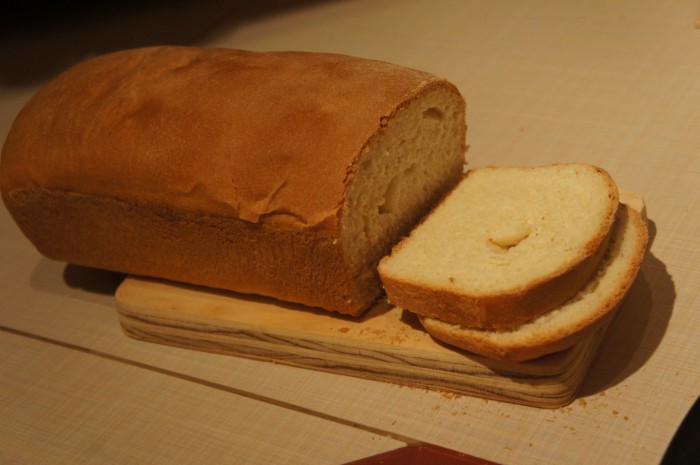
Transfer the loaves to a wire rack and let them cool for at least 1 hour. These store really well just in a plastic or paper bag on the counter. They don’t go stale as quickly as some crusty loaves, which was nice because it’s hard to burn through 2 loaves of bread with just 2 of us in the apartment. The bread was really good. A little sweet and a little tangy, and quite dense. At first, I was actually bummed about how dense it was (I wanted something light with lots of holes but I realized that with all the extra flour I added, that probably wasn’t gonna happen), but after eating a slice with butter, I was really digging it. We also used this bread to make the gratinées for the French Onion Soup we had for dinner last night (which I’ll be posting very soon).

A Loaf of Bread

bread
bread

bread

Remember a little while back (in the cheddar and sage biscuits post) when I said I had bought some yeast and wanted to use it to make some bread? So I finally did that. I was more than a little bit frightened, and while all did not go perfectly smoothly, it worked! Very cool!

I hunted online for a while for some beginner bread recipes. While I was tempted to jump in and start with crusty french loaves and sourdoughs and breads with all kinds of stuff in it (think garlic cloves, spices, onions, anything else you can dream of), I thought it best to start simply and try to figure this thing out. I found this recipe for just a basic white loaf which didn’t require me to go to the store and buy anything, so already I was a big fan.

I used my kitchenaid mixer because it makes life easier. But a lot of the recipes I read are like “it’s so easy you don’t even need a mixer!” Whatever.

Sandwich Bread

Makes 1 loaf

Ingredients

1 package of active dry yeast
1 1/2 tablespoons butter, melted
1/4 cup milk
5 teaspoons sugar
1 teaspoon salt
2 – 3 1/2 cups flour
cooking spray or other oil

Instructions

First, warm the bowl by filling it with hot water, then dumping it out. Then dissolve your yeast according to the directions on the packet. Stir until yeast is completely dissolved, with no lumps. I think this is where things started to get wonky for me. I think the recipe assumes your yeast packet will call for 1 cup of warm water, but mine only called for 1/4 cup.

Now add the butter, milk, sugar, and salt to the yeast and stir until it well blended (it will look like a slightly yellow-ish tan liquid). Now add 2 CUPS of flour. No more! Not yet! Mix this very well. If the mixture is still wet, add more flour 1/4 cup at a time, mixing well before adding anymore. Now the recipe I used called for at least 2 1/2 cups of flour, so I mixed in the 2 cups of flour, then pretty quickly added another 1/4 cup thinking it wouldn’t be a big deal. But a big deal it was, my friends. My dough immediately became too dry, crumbling into a million little pieces and it WOULD NOT come together. I was so frustrated! A couple other recipes I had read in my research had said “If your dough is too wet, add more flour. If it is too dry, add more milk/water.” So that’s what I did. I ended up adding probably almost another cup of milk/water. I think the important lesson here is that if you follow the instructions and it’s not perfect, it’s not the end of the world (which I thought it was). Just add a little of this, a little of that, it will all be ok.

Once the dough has come together, you can either let your machine knead it for ten minutes or, if you’re feeling adventurous dump the dough out onto a floured surface and knead it yourself. I did the latter because sometimes it feels better to know you’ve actually put in some physical effort. You know what I mean? There are many different kneading techniques. Some say you should punch the dough down, fold it up, then punch again. Some say you can squish it in your fingers and pull and twist it. I use the good old fashioned push away from you with the base of your palm and fold. Push and fold, push and fold.

I then rinsed out my mixing bowl, coated it in a little oil, put my ball of dough in it, covered it with a dishtowel, and let it rise for an hour in a warm place. Don’t clean up your floured surface, because you’ll need it again. The recipe says that after rising for an hour, your dough should double in size, but not to stress if it’s bigger or smaller than double. This was good news, because mine had not doubled. But it did rise, so we were still on the right track here. Now punch the dough down, and spread it out into a rectangular shape: one side the length of your bread pan, the other side 1 1/2 times the length of your bread pan.  Now roll that bad boy up, tucking the ends of the roll underneath (the bottom being where the seam is). Now drop it into the oiled bread pan.

Now you let it rise again, covered with a dishtowel. The recipe says an hour, but mine hadn’t really done much in that amount of time. Here’s where I thought things were going south again. After an hour of rising in the bread pan and not being where it needed to be, Jonah and I had to leave the house to go record his old a cappella group. I know, right? And then we went out to eat. So the dough sat in the pan rising away for a total of 5 1/2 or 6 hours. So I got home and I expected the bread to have exploded and that there’d be yeasty dough all over the apartment (why I suspected that, I have no idea). But no! It had risen the perfect amount!

At this point I’m starting to think that maybe I haven’t completely ruined this loaf of bread. I heated the oven to 400 degrees and baked that sucker for 30 minutes. Once you take it out of the oven, immediately remove the bread from the pan so it doesn’t continue cooking. The recipe says to let it cool all the way before eating. And check it out!

After it cooled and Jonah and I each ate a slice, I was so dang proud of myself. After thinking I had ruined it twice, it worked! And not only that, but our apartment smelled so incredibly delicious. Oh my goodness. This bread makes amazing toast, and tastes wonderful with just a little butter spread on it. And now that I’ve done it once, I feel ready to tackle the world of bread. Keep an eye out for more bread recipes coming soon!

French Toast (with a secret ingredient)

French Toast

French Toast
French Toast

This past weekend my mom came to town to hang out, and we had her, her boyfriend, and his son over for breakfast on Sunday morning. I thought it would be nice to make the french toast that she used to make for me growing up. Hopefully my mother doesn’t kill me for posting her secret ingredient online for all the world to see.

French Toast

Ingredients

Bread of some kind – we used a baguette cut into thing pieces at a diagonal so they were bigger. If the store had challah, we would’ve used that, but they didn’t.
VANILLA ICE CREAM
Eggs
Cinnamon and whatever other spices you want – we used a pinch of nutmeg.

Instructions

Melt 1 1/2 – 2 scoops of ice cream in a wide, shallow bowl (like the one Jonah is using in the pictures above and below). Wait until the ice cream soup has cooled from melting, and add 2-3 eggs. Whisk together. Add 1/2 tsp cinnamon and a pinch of nutmeg. Soak your bread in egg mixture: we press it down to make sure it gets nice and wet. Melt butter in a pan over medium heat, and add bread. Cook until lightly browned on both sides.

The key, in my opinion, is having the toast perfectly done on the outside but still making sure that all the eggy stuff is cooked on the inside. Sometimes it helps to pop them in the oven on a low temperature: 1) it keeps the toast warm while you’re finishing up the cooking and 2) it helps cook the inside.

We served the french toast with syrup, greek yogurt, and fruit. It was quite delicious, and I think everyone enjoyed it thoroughly. I can also see replacing the ice cream with eggnog for the holiday season (because what isn’t good with eggnog?)!