Tag: Asian

Momofuku Noodle Bowl

Momofuku Noodle Bowl

Momofuku Noodle Bowl

For those of you who saw the title of this post and went “What the hell is a Momofuku?” let me explain. Momofuku is a group of restaurants in New York owned by Chef David Chang. The group includes Momofuku Noodle Bar, Momofuku Ssam Bar, Milk Bar, and a few more. Anyway, I became mildly obsessed when I bought my dad the Momofuku cookbook for his birthday last year (he was obsessed after having eaten at one of the restaurants on a trip to NYC). Momofuku translates in Japanese as Lucky Peach, which is the name of a magazine that David Chang has recently published, all about cooking and eating. It includes articles by some other chef favorites like Anthony Bourdain, Wiley Dufresne, and Mario Batali.

Anyway! I found this recipe for a Momofuku noodle bowl on a blog called A Cozy Kitchen, which I’ve used before and I really enjoy. While the recipe is a little ingredient heavy, it’s really delicious, so although it may be a little extra work to get all this stuff (luckily Jonah and I already had the Asian ingredients), it’s worth it. We use stuff like soy sauce and rice wine vinegar all the time. They’re handy things to have around for a quick and easy meal (feeling lazy? marinate some chicken in soy sauce, mirin, garlic, and olive oil). We did fudge some things though, so I’m putting in the actual recipe and in parentheses what we did.

Momofuku Noodle Bowl

Ingredients

1 medium sized cucumber
¼+ tsp salt
½+ tsp sugar
2 ½ cups (or one bunch) thinly sliced scallions
½ cup (or just one large piece) minced ginger
¼ cup grapeseed oil (we used olive oil because we didn’t have grapeseed)
2 tsp soy sauce
1 tsp rice wine vinegar
1 Tbl olive oil
½ large head of cauliflower, cut into florets
1 lb noodles – ramen, soba, or lo mein (we used udon)

Instructions

Thinly slice the cucumber. In a bowl toss the cucumber with salt and sugar and let it sit for a few minutes and then taste one of the slices. Adjust the salt and sugar as necessary. I ended up probably using twice or even 3 times as much sugar and salt. Just because I wanted it. Thought it tasted better.

In a different bowl combine the scallions, ginger, 1/4 cup of olive oil, soy sauce and rice wine vinegar. Allow to sit and marinate for 30 minutes.

While those items are marinating, heat the Tbl of olive oil in a pan and add the cauliflower. Cook them on high till they start to brown and get a bit crispy. While the cauliflower is cooking, you can boil water and cook your noodles according to the package. Once the noodles are cooked, toss them with the scallion/ginger sauce. Now, serve the noodles in a bowl, and top with the cauliflower and cucumbers.

Now, this is a vegetarian dish, but Jonah and I were hankering for some more protein, so we bought a chicken breast. Jonah cut it up into bite size pieces and cooked it with a bit of fish sauce, hoisin sauce, and soy sauce, and it was good. A delicious addition to the dish. Yum!

Restaurant Review: Biwa (and Ramen!)

This past Monday night, Jonah and I decided to head out into the city to get some food. We’ve both had a cold for a little while now, so we were riding the wave of Asian soup. Saturday night we went to Thai Peacock (a funny little Thai place by Powell’s with the best Tom Ka Gai I’ve ever had), and Sunday night we made pho (and decided the pho at Mekong, the place a block from our house, is superior to anything we could ever make ourselves). I’d read in the Portland Monthly Best Restaurant edition that Biwa is the place to go for ramen, and had been wanting to try it since.

Lucky for us, because it was a Monday night, it wasn’t packed. That being said, there were a couple large parties waiting for tables, and Jonah and I opted to eat at the bar to avoid waiting because we were super hungry. We pretty quickly decided on what to order, choosing to stick with familiar dishes since we were both sick and not feeling terribly adventurous. Jonah got a housemade ginger soda (which I was jealous of and of which I probably drank at least half).

I must say, that while ordering, I noticed that the restaurant has a little bit of a boys’ club vibe. All the cooks and all but two waiters were men, and I felt a little funny being a girl. The men were all very stereotypically “Portland”: facial hair, flannel shirts, skinny jeans, tattoos. I felt a little out of my element, which was odd to me. That being said, our waiter was very nice, though quick and with a very dry sense of humour (or maybe he was being serious… I couldn’t really tell).

We ordered the cucumber sunomono (vinegared cucumber salad with shrimp and seaweed), agedashi tofu (my favorite Japanese dish, fried tofu in broth), and of course, a bowl of ramen.

Ramen at Biwa
A beautiful bowl of delicious Biwa ramen.

The cucumber salad was delicious. Thinly sliced cucumbers with seaweed doused in delicious vinegar with huge juicy shrimp… Oh my goodness. I could have eaten a few of those and gone home happy. It was light and refreshing. I want to go back on a hot summer’s day and eat that dish. The agedashi tofu was also magnificent. Much lighter than most of the agedashi tofu I’ve had before: the tofu was more delicate, the batter was much lighter, and the broth tasted less “packaged,” if that makes sense. It was unique and delicious. I love soaking the crispy fried tofu in the broth and letting it soak up the flavor. Yum.

Now onto the ramen. It was delicious. The noodles were amazing, just the right texture, and very fresh tasting. The meat was some thinly sliced pork and was actually largely fat, which sometimes throws me off. But this fat had a wonderful texture that just fell apart in your mouth and tasted so rich and delicious. One thing I wasn’t crazy about, which I wanted to be crazy about, was the egg. The shoyu egg, which I think means they’ve been soft or hard boiled and then cooked in soy sauce, was a little…sweet? I’m not really sure what the taste was. Perhaps it’s just that I wasn’t used to the preparation of it, but I wasn’t a crazy big fan. The broth of the soup was good, but about halfway through the bowl, both Jonah and I were chugging our water because it was so salty. It was so salty that we almost asked our waiter if it was supposed to be like that or if it was over-seasoned or something. I can appreciate some salt as much as the next girl, but it was pretty extreme. But still delicious. Just… in smaller doses.

Overall, I was happy with our meal at Biwa. Next time I want to be a little more adventurous and also want to try their other noodle soup (udon. yum.). The atmosphere was nice, and the food was delicious, particularly the small plates. I would definitely recommend it for a diner who is interested in more traditional Asian cuisine with a touch of flare.

Spicy-Miso Salmon and Citrus Rice Bowl

Salmon rice bowl
Miso Salmon
Miso Salmon

Miso Salmon

This meal all started because Annie gave me a wonderful Christmas present: The Sriracha Cookbook.  You’ve probably seen Sriracha at your local asian restaurant, and you may know it as “rooster sauce” – or if you don’t know it, its basically an asian hot sauce made with chiles and garlic and its ohhh so good.  And you need it for the recipe that follows.

So the Sriracha Cookbook, as one might expect, is chock full of recipes that include Sriracha in them.  I picked the Miso-Sriracha Glazed Salmon recipe for dinner, mostly because we already had miso paste and Sriracha in our house.  The recipe in the book tells you to serve it atop steamed rice, but I wanted to do something more interesting, so I found a great recipe on Martha Stewart.com that I adapted to include the miso-Sriracha salmon.  Its a wonderful rice bowl that includes salmon, orange slices, and sugar snap peas atop some brown rice with a great orange sauce and mint to sprinkle on top of it all.  It tasted so light and substantial at the same time, and was a wonderful meal in a bowl!

A note on the rice: I actually used a rice called Camargue Red Rice, which Annie’s mom brought us from the south of France, where it grows.  The package had no English on it so I actually had to get online and do a little research before cooking it.  Anyway, it was delicious but I don’t think its necessary to make this dish great, so I put brown rice in the recipe below.

Spicy Miso Salmon and Citrus Rice Bowl

Ingredients

Spicy Miso Salmon

1/2 Tb. toasted sesame oil
1/4 cup brown sugar
2 Tb. soy sauce
2 Tb. white miso paste
1/2 Tb. Sriracha
1 clove garlic, minced
1 lb. salmon fillet(s)

Citrus Rice Bowl

4 oranges (I used Valencia)
A 1-inch piece of fresh ginger, peeled and thinly sliced
1 bay leaf
1 tsp. coriander seeds
1 Tb. rice vinegar
1 tsp. soy sauce
1 tsp. honey
1 tsp. toasted sesame oil
1 cup uncooked brown rice
1/2 cups sugar snap peas
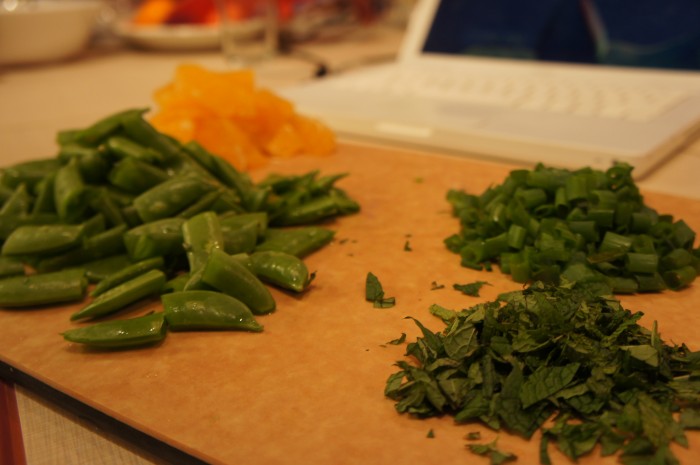
1/4 cup fresh mint, chopped, for garnish
sliced green onions, green part only, for garnish

Instructions

Cook the rice according to the package directions.  I added a bit of chopped garlic and butter into 3 1/3 cups of water, brought it to a boil, and then simmered for about an hour.

In a small mixing bowl, make the Spicy Miso Salmon glaze: combine the oil, brown sugar, soy sauce, miso paste, Sriracha, and garlic.  Set aside.

Peel and separate 2 oranges into individual boats.  Now comes the hard part: you are supposed to detach and discard the membranes in order to get to the meat of the orange slice.  I experimented a lot during this step, and eventually found that I could cut down the back of each orange segment, pull it apart, and pull off the membrane from each side.  You could just skip this step entirely, but the orange slices won’t look as pretty, and you won’t get the same taste.  Regardless, put these orange segments in a bowl and set aside.

Remove the stems from the sugar snap peas, rinse, and chop into 1/2-inch pieces (I just chopped each pod in half).  Set aside.

Now juice the remaining 2 oranges into a small saucepan, and add the sliced ginger and bay leaf.  Crush the coriander seeds with the side of a knife and add them to the orange juice mixture, then bring to a boil.  Cook the mixture until it reduces to about 2/3 cup, about 6 minutes.  Take it off the heat and let it cool, then strain into a bowl to get rid of the ginger, bay leaf, and seeds.  Now whisk in the vinegar, soy sauce, honey, and oil.

Preheat the broiler to high. Lay the salmon fillet(s) across an aluminum foil-lined broiling pan (or any baking sheet with a rim).  Take out the glaze you made in step 2 and spread it generously on top of the salmon.  Broil the salmon 6 inches from the flame (or heat coil, as the case may be), until the fish flakes easily, about 10 minutes.  I spread more of the glaze on the fish after 5 minutes of broiling.

Dish the rice into bowls, and top with salmon, peas, and orange segments. Garnish with mint and green onion slices.  Reheat the orange sauce/mixture if it needs reheating, and drizzle it generously over everything.

Enjoy!

Soy Glazed Salmon and Asparagus with Miso

Soy Glazed Salmon and Asparagus with Miso

Soy Glazed Salmon and Asparagus with Miso

Soy Glazed Salmon and Asparagus with Miso

The other day Jonah and I were feeling up to cooking a big fancy meal. I picked the menu: Soy Glazed Salmon, Eggplant with Miso, served with rice. We got to the store and they didn’t have eggplant though, so I picked up some asparagus instead. Not sure why. But it was the right decision. This salmon is so unbelievably easy. Boil some delicious stuff in a put, put it on a hunk of fish, cook it, put on more stuff, and then eat it. Oh my goodness.

While Jonah was making the salmon, I had to find a new recipe. Lucky for me, I types in “asparagus with miso” and I quickly found a delicious recipe on…Oprah.com. I adjusted ingredients based on what we had as well as some of the eggplant recipes I’d read.

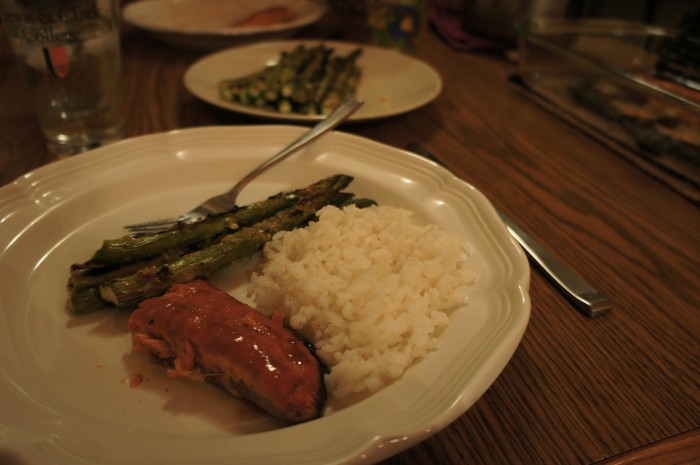
This meal was honestly one of the easiest, most delicious meals I’ve had. I have a tendency when I cook fish to put too much sauce or whatever on it so that it doesn’t really tasted like fish anymore. This salmon still tasted like salmon, but with a little kick of salty and sweet, it was perfect. And the asparagus had little charred bits (which I love) and was a little sweet, a little spicy, and a little tart. They tasted delicious together too. I highly recommend cooking this meal when you want to impress but don’t want to do too much work.

Soy Glazed Salmon with Miso Asparagus

Ingredients

Soy Glazed Salmon

1 lb salmon
1/8 cup soy sauce
1/8 cup maple syrup

Miso Asparagus

1/8 cup miso paste
1-2 clove garlic , minced
1 teaspoon minced fresh ginger (I didn’t have fresh ginger, so I used about half a teaspoon of powdered ginger, I’m sure more than that would be good too)
2 teaspoons fresh lime juice
1 pinch red pepper flakes
1/2 tablespoon sugar (to make it caramelize a little bit)
1 tablespoon mirin
3/4 pounds asparagus , bottoms trimmed
1/2 tablespoon olive oil
Pinch of salt

Instructions

Soy Glazed Salmon

Preheat oven to 450 degrees. The recipe (from the Gourmet Today cookbook which we got on sale at Powell’s for $15) says to line a broiler pan with foil and then oil the broiler rack. We don’t have those things, so we just used an oiled pyrex baking dish, which worked just fine.

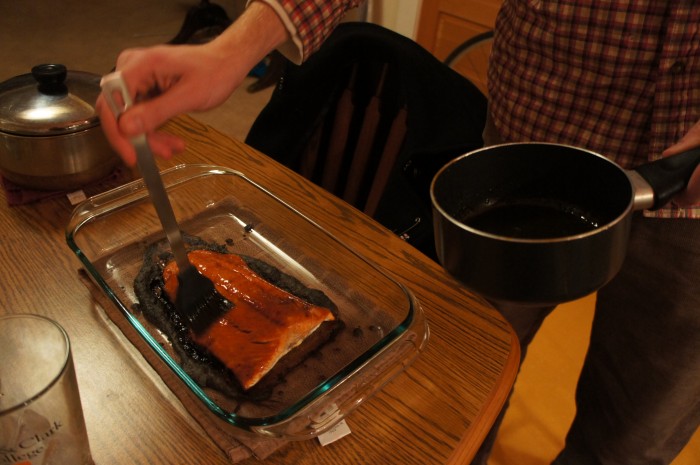
Bring the soy sauce and maple syrup to a boil in a small saucepan over medium heat, uncovered, and boil until it reduces to a little more than half (of what you originally had). Put salmon skin-side-down in the dish or on the pan or whatever and pat dry. Set some of the glaze aside for later, and brush the salmon generously with the remaining glaze. Let stand for 5 minutes, then brush again with glaze. Roast the salmon for 10 minutes in the oven. Turn on broiler, brush salmon with glaze again and broil close to the heat (think 6 inches or so, no need to be terribly exact) until cooked through, 3-5 minutes. Once you take the salmon out of the oven, you can brush on the remaining glaze.

Miso Asparagus

Preheat broiler. In a small bowl, combine all ingredients EXCEPT asparagus, olive oil, and salt. Stir well and set aside. On a baking sheet, toss asparagus with olive oil and salt. Cook close to heat (about 6 inches) for about 3 minutes (if you like softer asparagus, like me, cook for 4 minutes), then remove from oven. Spread miso mixture over the asparagus and place back under broiler for 3-5 minutes.